Social Studies Quest
Social studies workbooks for kindergarten to 8th grade
Social studies is the subject that explains a child's world. It starts close to home, with families, neighborhoods and the people who keep a community running, and widens every year: maps and how to read them, where money comes from, how laws are made, and how the country and the world came to be the way they are. A good social studies workbook follows that path in order, so each year makes sense of the one before.
Lumi's Social Studies Quest workbooks do exactly that. There is one printable workbook for each grade from kindergarten to 8th grade, each following Lumi Academy's social studies year lesson by lesson, in the same order the app teaches it.
How each workbook is built
- Learn boxes open every lesson with one idea in plain words, like what a map key is for or why the colonies wanted independence.
- Questions follow straight away, most with choices to circle.
- Units group the lessons, from a Day 1 lesson to a Year End lesson that reviews the year.
- An answer key and progress chart sit at the back, so checking work takes seconds and children can see how far they have come.
Social studies by grade
Kindergarten: Community, Family, Maps, Money and American Symbols
234 lessons and 466 questions across 96 pages. Kindergartners learn about helpers in the community, rules and why we have them, simple maps, needs and wants, and symbols like the flag.
Grade 1: Family, Government, Maps, Money and American History
239 lessons and 470 questions. First graders compare life then and now, meet leaders and laws, learn the difference between goods and services, and find places on a map.
Grade 2: Maps, Money, Government and American History
209 lessons and 467 questions. Second grade adds landforms, earning and saving, the Declaration of Independence and the people who shaped early America.
Grade 3: Maps, Government, Money and Early American History
The largest book, with 343 lessons and 832 questions on 152 pages. Third graders study the regions of the United States, state capitals, famous landmarks, the founding documents, and how a bill becomes a law.
Grade 4: Early American History, Maps, Government and Money
208 lessons and 486 questions. Exploration and the colonies, the American Revolution, the physical geography of the country, and how the three branches of government share power.
 Social Studies Quest Workbook: KindergartenCommunity, Family, Maps, Money and American Symbols$12.99 PDF
 Social Studies Quest Workbook: Grade 1Family, Government, Maps, Money and American History$12.99 PDF
 Social Studies Quest Workbook: Grade 2Maps, Money, Government and American History$12.99 PDF
 Social Studies Quest Workbook: Grade 3Maps, Government, Money and Early American History$12.99 PDF
 Social Studies Quest Workbook: Grade 4Early American History, Maps, Government and Money$12.99 PDF
Grade 5: America in the 1800s, Government and Modern American History
193 lessons and 473 questions. Westward expansion, the Civil War and Reconstruction, the Progressive Era and the 20th century, plus the Constitution and the rights it protects.
Grade 6: Ancient Civilizations, the Middle Ages and the Renaissance
209 lessons and 562 questions. Sixth grade travels the world: early farming and the first cities, ancient Egypt, Greece, Rome and China, the Middle Ages, and the Renaissance and age of exploration.
Grades 7 and 8: history, government and citizenship
Grade 7 has 123 longer lessons and 334 questions on early American history, government and citizenship, the Middle Ages, the Renaissance and modern America. Grade 8 has 83 lessons and 224 questions on modern American history, government and America in the 1800s.
 Social Studies Quest Workbook: Grade 5America in the 1800s, Government and Modern American History$12.99 PDF
 Social Studies Quest Workbook: Grade 6Ancient Civilizations, the Middle Ages and the Renaissance$12.99 PDF
 Social Studies Quest Workbook: Grade 7Early American History, Government and Citizenship, the Middle Ages, the Renaissance and Modern America$12.99 PDF
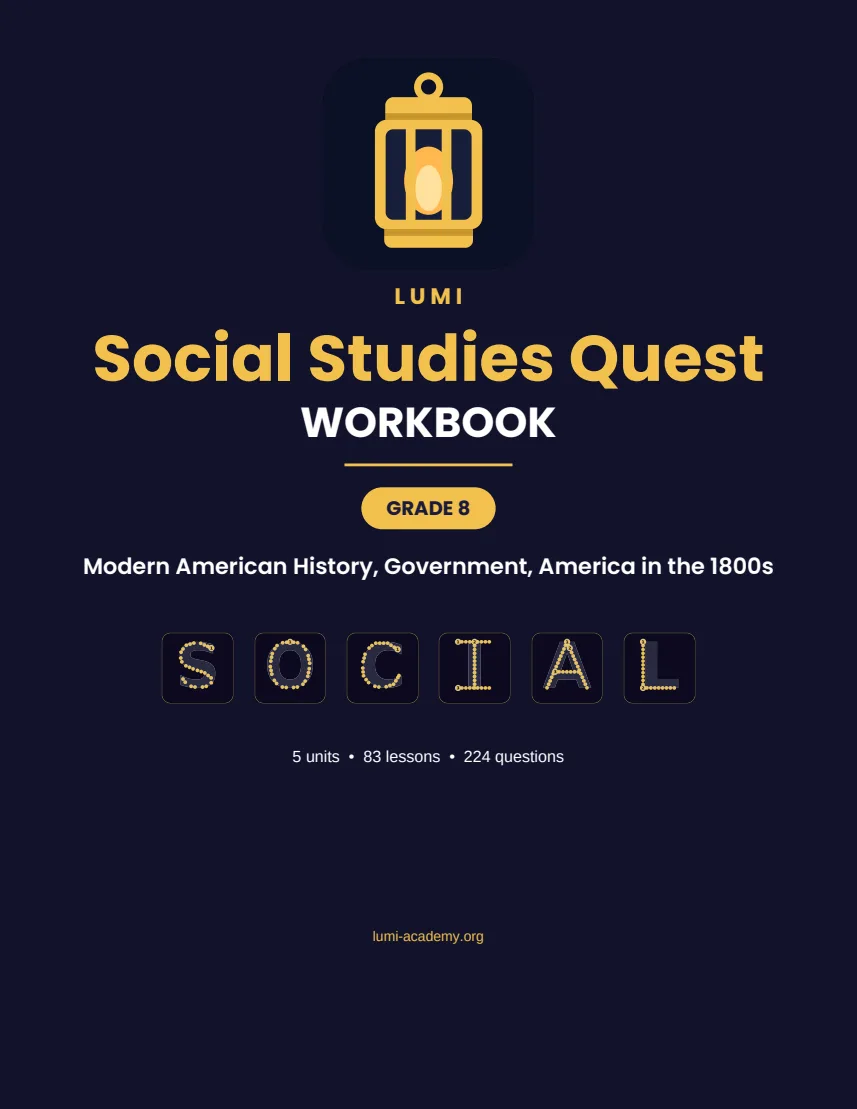 Social Studies Quest Workbook: Grade 8Modern American History, Government and America in the 1800s$12.99 PDF
Choosing a grade
Start with your child's current grade. Social studies revisits big ideas, like maps, money and government, every year at a deeper level, so children who missed a year can join at grade level. If your child is a strong reader who loves history, their grade will still have plenty that is new, especially in the later units.
Making social studies stick at home
Social studies comes alive when it connects to real life. A few easy ways to do that while you work through the book:
- Use a real map. After a map lesson, find your street, your town and the nearest river on a road map or an atlas.
- Talk about money at the store. Needs, wants, saving and prices all make more sense with a real shopping list.
- Visit a local place. A post office, fire station, town hall or museum turns a lesson about community helpers or history into a memory.
- Read a story from the same time. A library book set in colonial times or ancient Egypt adds the people and details a workbook cannot.
Why print social studies
Social studies is full of names, dates and places that are easier to remember when a child writes about them. A printed page also makes it simple to keep a record of the year for a homeschool portfolio, and it lets the whole family see the same lesson at the dinner table instead of passing a device around.
Using Lumi already? Social Studies Quest matches Lumi Academy social studies lesson for lesson, so the book and the app always line up.
Build a full grade
Social studies pairs naturally with reading and science. Many families pick the same grade in Science Quest, Reading Quest and Math Quest to cover the core subjects for a year. See workbooks for all subjects for a grade-by-grade view.
Questions parents ask
What grades do the social studies workbooks cover?
Kindergarten through 8th grade, one workbook per grade. Each book is a full year of social studies, starting with a Day 1 lesson and ending with a Year End lesson.
What topics do the workbooks teach?
Early grades focus on family, community, maps, money and American symbols. The middle grades add government and early American history. Grade 6 turns to ancient civilizations, the Middle Ages and the Renaissance, and Grades 7 and 8 cover American history, government and citizenship in more depth.
Is there an answer key?
Yes. Every question's answer is at the back of the book, along with a progress chart to color in as each unit is done.
Do the workbooks cover my state's history?
The books teach United States history, geography, government and economics, plus world history in the upper grades. They do not include state-by-state history, so add a local library book if your state requires it.
Which social studies workbook is the biggest?
Grade 3, with 343 lessons, 832 questions and 152 pages.
How long does each workbook take?
Each book is planned as one school year. Two or three lessons a day, three or four days a week, finishes most grades on time.
Find your book
Every Lumi book is a PDF you download right after you pay. Print at home as often as your family needs.
See all 102 books