Spelling Quest
Spelling workbooks for every grade, Pre-K to 12
Spelling sticks when it follows a plan. A child who learns the magic e rule in one week and then practices hope, kite and cube all week remembers far more than a child handed a random list on Monday and tested on Friday. Lumi's Spelling Quest workbooks give every grade, from Pre-K to 12th, that kind of plan: 30 weeks, one pattern at a time, with review built in.
How every Spelling Quest workbook works
All fourteen books share one shape, so moving up a grade feels familiar. Each week takes two pages:
- This week's rule, in plain words. For example: oi and oy say oy, or wh says w, like in whale.
- Trace and write. Each word appears in gray to trace, then on a line to write alone.
- Circle the pattern. Find the part of each word that follows the rule.
- Fill in the blank. Read a sentence and write the missing word, so spelling and meaning stay together.
- Heart words in Kindergarten to Grade 5: two tricky sight words a week, learned by heart.
- The week quiz, read aloud by a grown-up while the child writes each word.
Review weeks bring back earlier words so they move into long-term memory. Every book ends with an answer key and a progress chart to color in.
What each grade covers
Early years: Pre-K to Grade 2
Pre-K, First Sounds: all 26 letters and their sounds. Kindergarten, Short Vowel Words: short vowels, word families, digraphs and blends. Grade 1, Digraphs, Blends and Magic E: sh, ch, th, blends, magic e, then vowel teams and plurals. Grade 2, Vowel Teams and Bossy R: ai, ay, ee, ea, ar, or, er, soft c and g, contractions and suffixes.
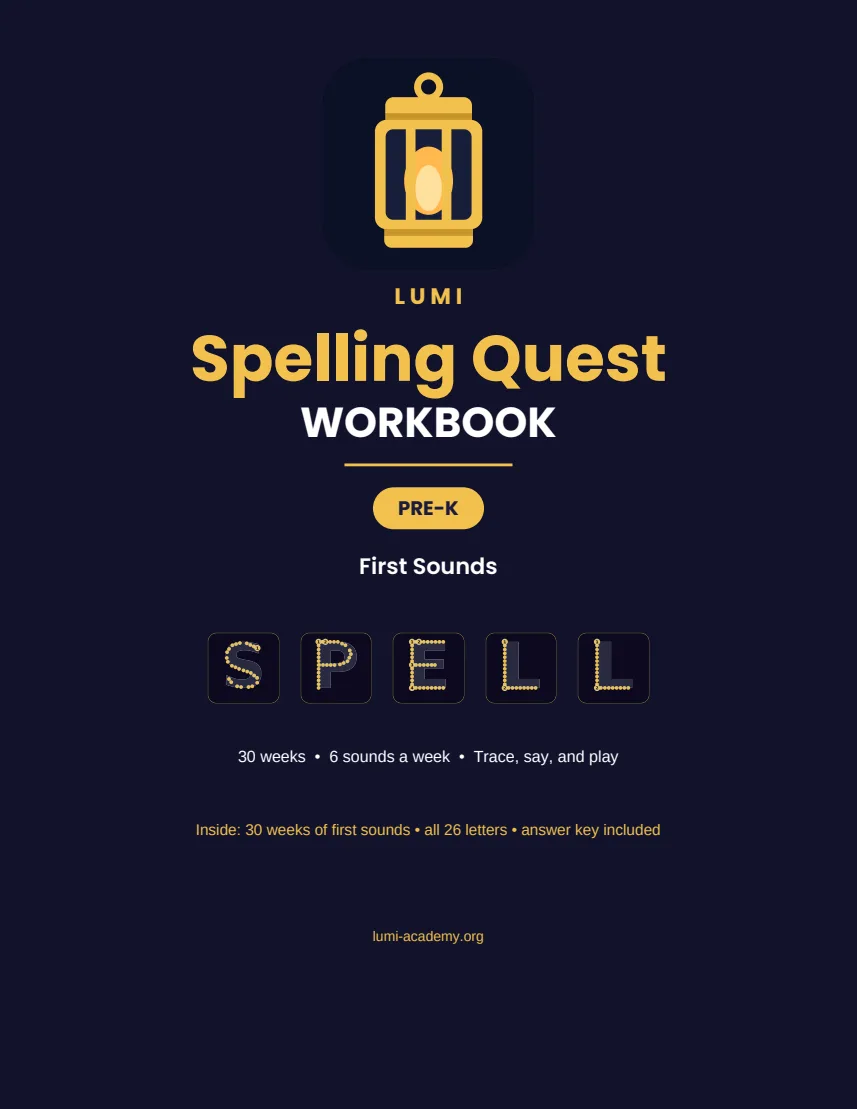 Spelling Quest Workbook: Pre-KFirst Sounds$12.99 PDF
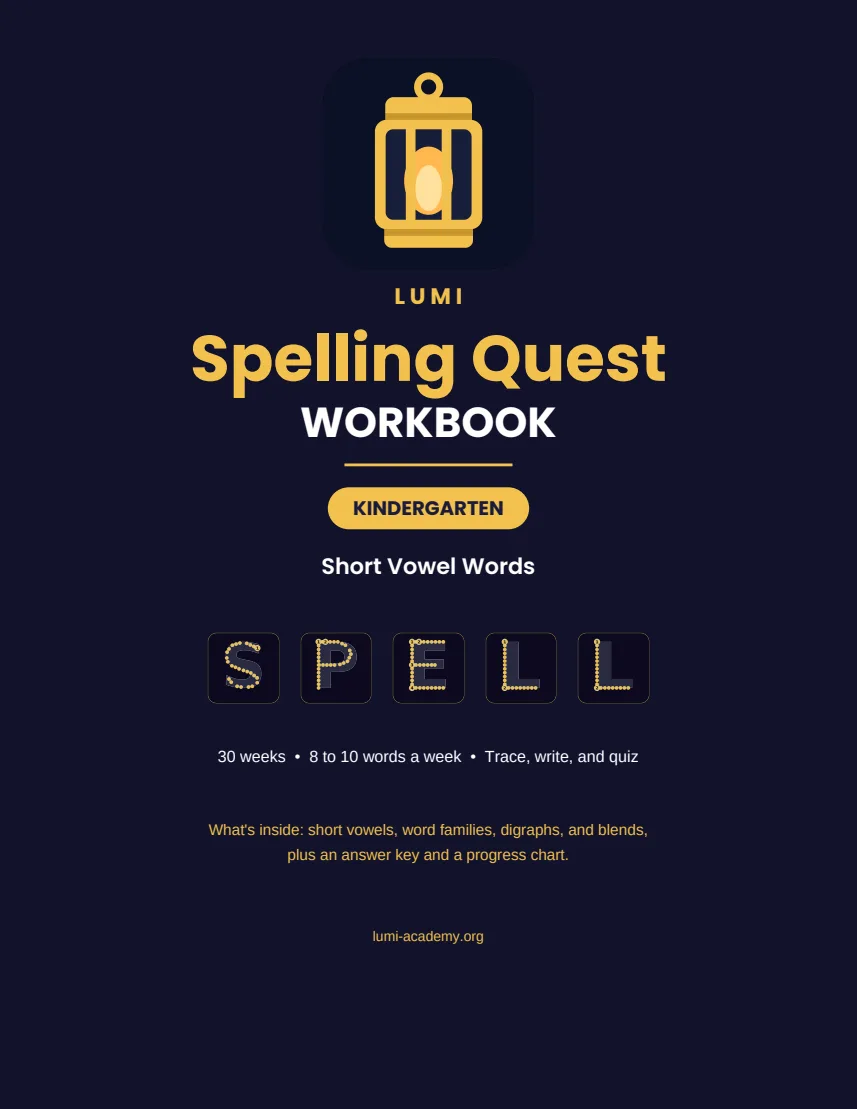 Spelling Quest Workbook: KindergartenShort Vowel Words$12.99 PDF
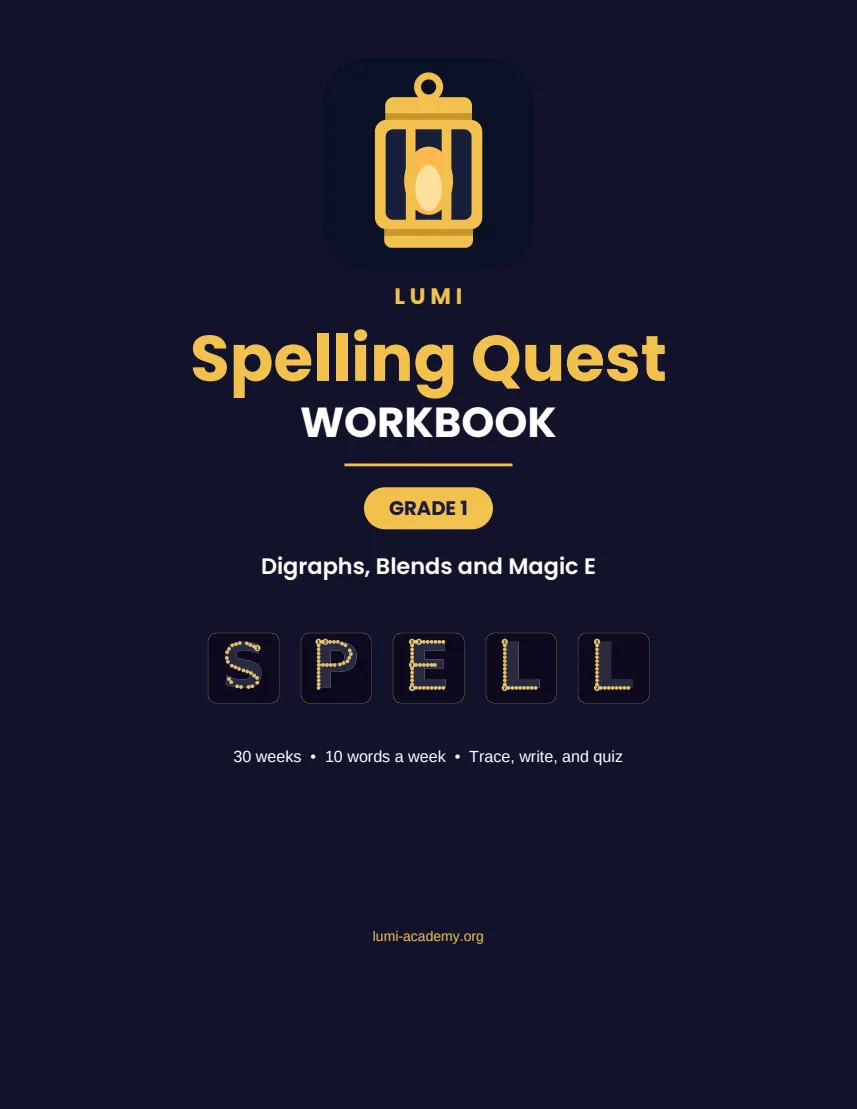 Spelling Quest Workbook: Grade 1Digraphs, Blends and Magic E$12.99 PDF
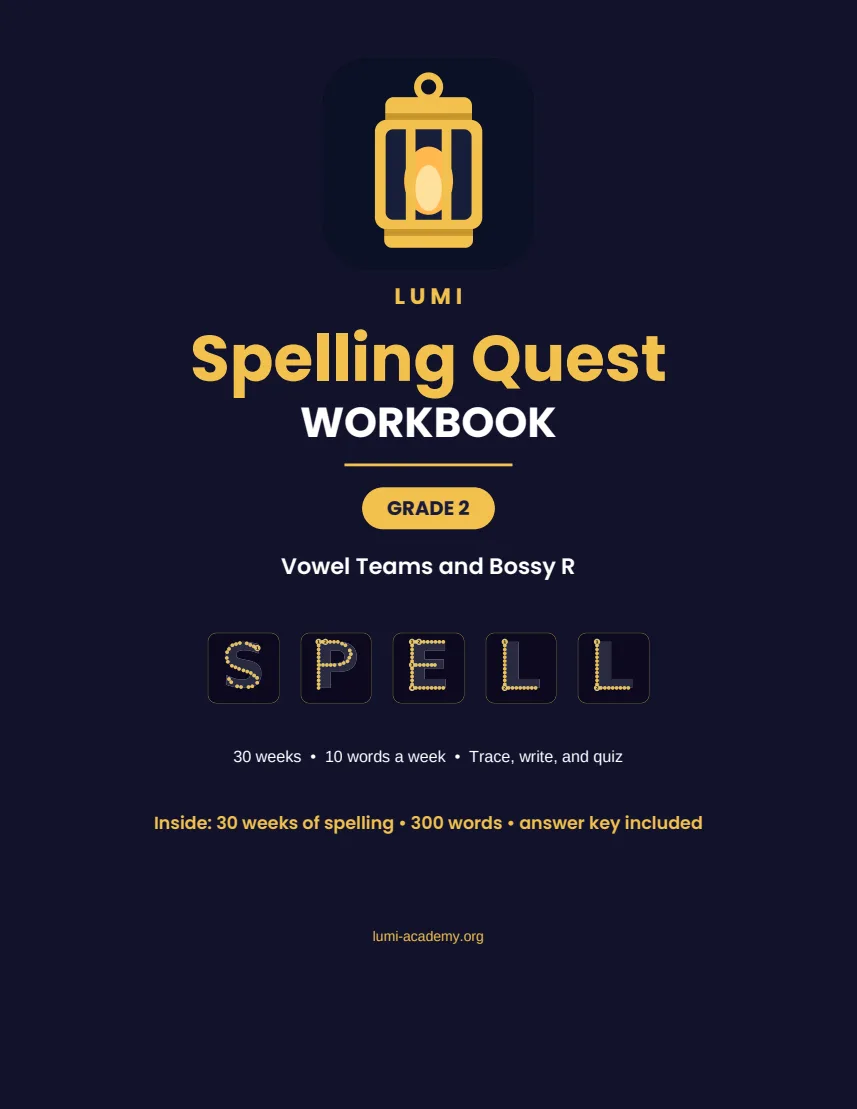 Spelling Quest Workbook: Grade 2Vowel Teams and Bossy R$12.99 PDF
Middle elementary: Grades 3 to 5
Grade 3, Tricky Sounds and Homophones: oi and oy, ou and ow, silent letters, homophones, the doubling and drop-the-e rules. Grade 4, Word Parts: -tion and -sion, prefixes and suffixes, -le endings, and first Greek and Latin parts like auto and aqua. Grade 5, Greek and Latin Roots: port, spect, struct, dict, tract, rupt and more.
 Spelling Quest Workbook: Grade 3Tricky Sounds and Homophones$12.99 PDF
 Spelling Quest Workbook: Grade 4Word Parts$12.99 PDF
 Spelling Quest Workbook: Grade 5Greek and Latin Roots$12.99 PDF
Middle school: Grades 6 to 8
Grade 6, Roots in Science and History: bio, geo, hydr, chron and therm, plus government, math and technology words. Grade 7, Tricky Prefixes and Academic Words: prefixes that change spelling, like in- becoming il-, im- and ir-, and roots like scrib, duct and ject. Grade 8, Academic and Content Words: ie or ei, double-consonant traps, and words from civics, chemistry and algebra.
 Spelling Quest Workbook: Grade 6Roots in Science and History$12.99 PDF
 Spelling Quest Workbook: Grade 7Tricky Prefixes and Academic Words$12.99 PDF
 Spelling Quest Workbook: Grade 8Academic and Content Words$12.99 PDF
High school: Grades 9 to 12
Grades 9 and 10, High School Word Power: roots like bene, voc, path, loqu and jur, literary and rhetoric terms, and commonly confused pairs. Grades 11 and 12, College Ready Words: college-level vocabulary, formal writing transitions, and words for law, economics, medicine and adult life.
 Spelling Quest Workbook: Grade 9High School Word Power I$12.99 PDF
 Spelling Quest Workbook: Grade 10High School Word Power II$12.99 PDF
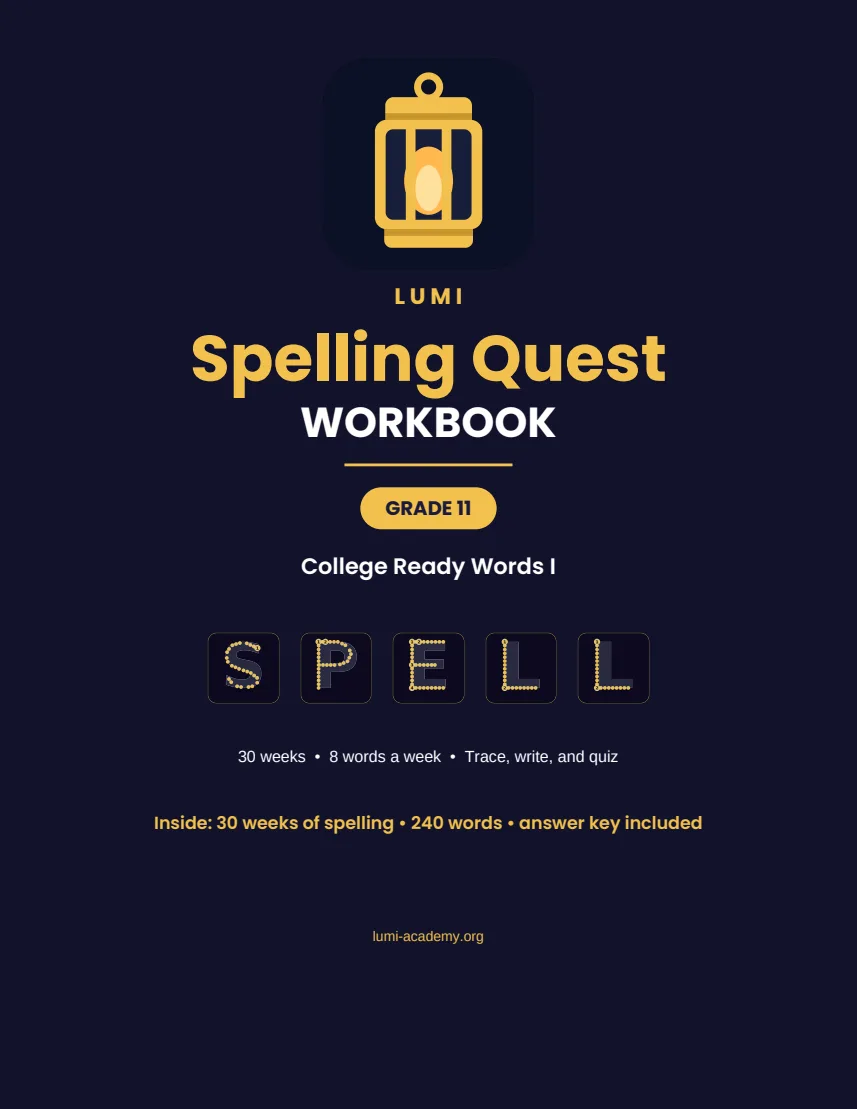 Spelling Quest Workbook: Grade 11College Ready Words I$12.99 PDF
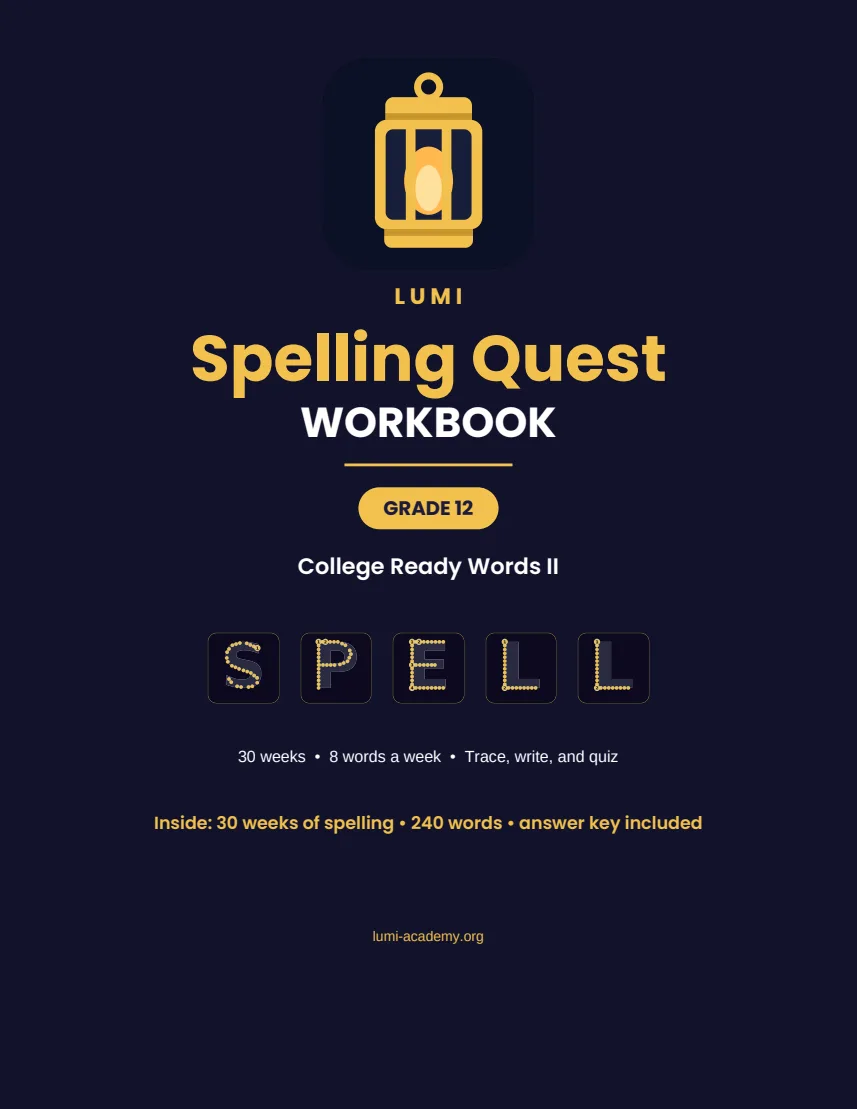 Spelling Quest Workbook: Grade 12College Ready Words II$12.99 PDF
Why a pattern-based spelling workbook beats word lists
Memorizing a list works until the test. Patterns work for life. When a child understands that -tion says shun at the end of nation, action and station, they can spell words that were never on any list. That is why each Spelling Quest week is built around one rule, and why the upper grades focus on roots: a student who knows spect means look can spell and understand inspect, spectator and perspective.
All the words are free. Every Spelling Quest word is in our open spelling word lists and on the grade pages, like 3rd grade spelling words. Use them however you like. The workbooks add the art, activities, review weeks and answer key, ready to print.
How to fit spelling into your week
Fifteen minutes a day is enough. A simple rhythm: Monday is the rule and trace-and-write, Tuesday to Thursday are the pattern and sentence pages, and Friday is the quiz. Missed words go on a sticky note and come back in the next review week. If your family also uses Lumi's app, the workbook weeks match Spelling Quest on screen, so a child can practice on paper and play the same week in the app.
Choosing the right grade
Grades are a starting point, not a rule. Open the book's page and turn through the preview: the Contents page and a week 14 sample show how hard the book gets. A child who spells most week 1 words already should try the next grade. If you are building spelling alongside reading for a beginner, our guide to phonics workbooks shows how the early spelling books pair with the reading books.
Questions parents ask
Which spelling workbook grade should I buy?
Start with your child's school grade, then look at the week 1 and week 14 sample pages on the book's page. If week 1 feels too easy, try the next grade. If week 1 is hard, go down one grade. The skills build in order, so a slightly easier start costs nothing.
How many words are in each spelling workbook?
Pre-K has 180 first sounds. Kindergarten has 260 words. Grades 1 to 5 have 300 words each, ten a week including two heart words. Grades 6 to 12 have 240 words each, eight a week.
Are the spelling words the same as Lumi's free lists?
Yes. Every word is in Lumi's open spelling word lists, free for anyone. The workbook is the art, the activities, the review weeks and the answer key built around those words.
Do high schoolers really need a spelling workbook?
The Grade 6 to 12 books are as much vocabulary as spelling: Greek and Latin roots, academic and content words, and college-ready words. Knowing how a word is built is how strong spellers handle words they have never seen.
Can I print a spelling workbook for each of my kids?
Yes. Each PDF can be printed as often as your own family needs, so siblings in the same grade can each work their own copy.
Find your book
Every Lumi book is a PDF you download right after you pay. Print at home as often as your family needs.
See all 75 books