The honest answer
There is no research-backed number of hours that makes a child well socialized. What the studies suggest, summarized in our guide to what research says, is that outcomes follow opportunity: regular, repeated contact with peers and trusted adults tends to go with good results, and isolation is the main risk. So the useful question is not "how many hours" but "is it regular, is it varied and does my child look happy and connected?"
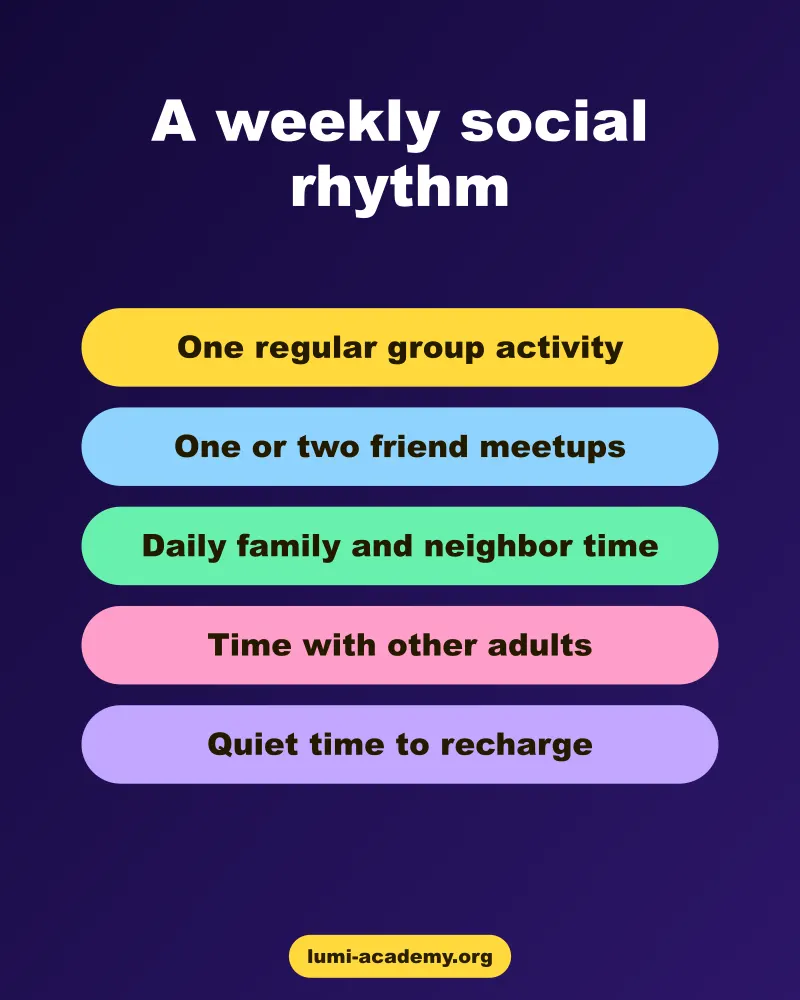
A simple weekly rhythm
| Type of time | Example | How often |
|---|---|---|
| A regular group | Co-op class, club, team, scouts | Once or twice a week |
| Friend time | A playdate or meetup with one or two friends | One or two times a week |
| Everyday contact | Neighbors, siblings, cousins, store and library chats | Daily |
| Other adults | Coach, teacher, librarian, mentor, grandparents | Weekly |
| Community | Church, volunteering, events | Weekly or monthly |
| Quiet time | Reading, play and downtime at home | Daily |
Treat the table as a starting point. A quiet child may thrive on less and a social butterfly may want more.
Signs it is working
- Your child talks about friends by name.
- They look forward to meeting people and are not dreading it.
- They can play, share and settle small disagreements.
- They are comfortable talking to adults.
- They have at least one friend they feel safe with.
Signs to add more
- They say they are lonely or bored with only family.
- They get overly clingy or very excited by any visitor.
- They struggle to play with others or to take turns.
- There is a long stretch with no contact outside the home.
Signs to add less
- They are tired, cranky or weepy after most outings.
- They are rushed from activity to activity and have no downtime.
- Learning at home suffers because every day is full.
- They ask for a quiet day.
Making it easier to keep up
- Put social time on the calendar, with the same priority as lessons.
- Choose recurring over one-off events.
- Combine goals: a club that is also a project, or a park day that is also PE.
- Share the work with other families so it does not all fall on you.
- Check in every couple of months and adjust.
If you cannot find a group, our co-op finder guide explains how to find or start one, and virtual co-ops can help while you build a local group.
A note for parents
Many parents worry that they are not doing enough. Remember that you are an important social partner for your child, as are siblings, grandparents and neighbors. Aim for a steady rhythm rather than perfection, and be kind to yourself when a week falls apart. A child who feels safe, loved and has at least one good friend is usually doing well.
- Plan a regular meetup in Circles and let families RSVP.
- Lumi's lessons keep learning steady so social time is not squeezed out.
- One flat plan covers up to 8 learners, with a free 48-hour trial to start.
Start the free 48-hour trial. No card is needed for the 48-hour trial. Circles is part of the paid Academy and High plans.
Frequently asked questions
How many hours of socialization does a homeschooler need?
There is no proven number. Regular, repeated contact with peers and trusted adults matters more than total hours, and the right amount depends on the child.
How often should homeschoolers see friends?
Many families aim for a regular group once or twice a week and one or two friend meetups, plus daily informal contact.
How do I know if my child has enough social time?
They talk about friends, enjoy meeting people, can play and take turns and are comfortable with adults.
Can homeschoolers be overscheduled?
Yes. If your child is tired, cranky or has no downtime, scale back.