Where the stereotype comes from
The idea that homeschooled kids are awkward is older than most of the research on it. It rests on a simple picture: kids who are not in a classroom must not be around other kids. That picture is wrong for most families. Homeschoolers spend time with peers through co-ops, sports, church, scouts, clubs, libraries and neighbors. What varies is how much, and how deliberately.
What studies have found
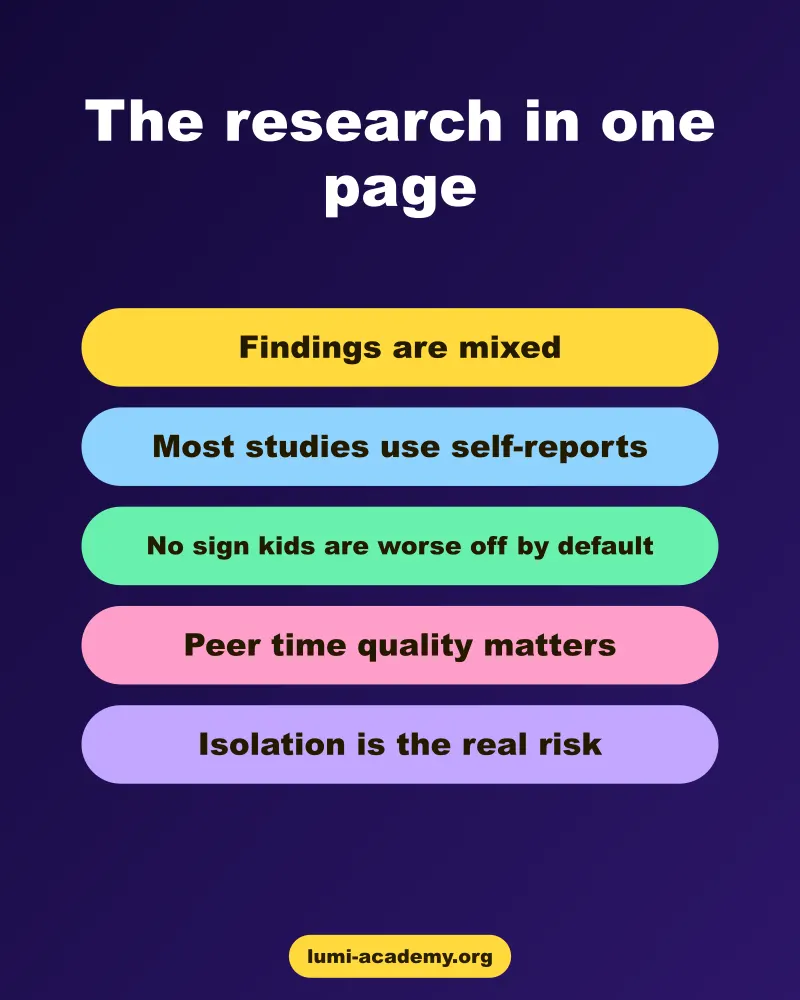
The research is mixed. A review summarized in Medlin's 2013 paper in the Peabody Journal of Education reports that, compared with conventionally schooled children, homeschoolers appear to have higher quality friendships and better relationships with their parents and other adults, though the underlying studies are small and often self-reported. Other studies have found no difference in measured social skills, and a few have found lower scores. The Coalition for Responsible Home Education research summary on socialization points out that many studies rely on self-reports from homeschooling parents and children, or on volunteer samples, which can tilt results. And the often-quoted claim that most studies favor homeschoolers traces back to an advocacy group, so read it with care.
| What studies suggest | What they cannot tell us |
|---|---|
| Homeschoolers are not, as a group, socially disadvantaged. | Whether homeschooling improves social skills. Families who choose it differ in many ways. |
| More chances for peer interaction go with better social outcomes. | The right amount for any one child. |
| Friendship quality and relationships with adults often look good. | How kids in isolated homeschooling families fare, since they are the hardest to study. |
| Results depend on the family and the child. | Long-term outcomes with large, neutral samples. |
The honest takeaway
The evidence does not support the idea that homeschooled kids are generally awkward. It also does not prove they are doing better than classroom kids. A reasonable reading of the mixed evidence is that social outcomes follow opportunity. For a general overview of the research on homeschooling, see this Psychology Today article. Kids who have regular, repeated time with peers and trusted adults tend to do well. Kids who are mostly isolated are the ones parents should worry about.
What this means for your family
- Plan it, do not hope for it. Put regular peer time on the calendar the way you schedule math.
- Prefer repeated contact. A weekly group builds friendships more than occasional big events.
- Include different ages. Siblings, neighbors, younger and older kids all teach different skills.
- Include other adults. Coaches, teachers, mentors and librarians all count.
- Match the child. A shy child may need fewer, smaller settings than an outgoing one. See our guide for shy and introverted kids.
Where to get started
If you are not sure how much is enough, our weekly socialization guide gives a simple way to check. For ideas, see activities by age, and for finding or starting a group, our co-op finder.
- Circles gives you a private place to find families and plan a weekly meetup.
- The optional kids' room lets children chat only with kids in their own co-op and age room, with parents reading everything.
- Lumi's lessons keep learning on track so the calendar has room for friends.
Start the free 48-hour trial. Circles opens with a paid Lumi Academy or Lumi High plan; the free 48-hour trial lets you try the lessons first, no card needed.
Frequently asked questions
Are homeschooled kids socially awkward?
Research does not support that as a general rule. Studies are mixed, and outcomes seem to depend on how much regular contact with peers and adults a child gets.
Do homeschoolers have fewer friends?
Not necessarily. Several reviews report friendship quality that is similar to or higher than that of classroom peers, though many studies rely on self-reports.
What is the biggest risk for homeschoolers socially?
Isolation. Kids with little regular contact with peers and other adults are the ones parents should watch most closely.
How can I make sure my homeschooler is well socialized?
Schedule regular, repeated peer activities, include different ages and other trusted adults, and match settings to your child's personality.