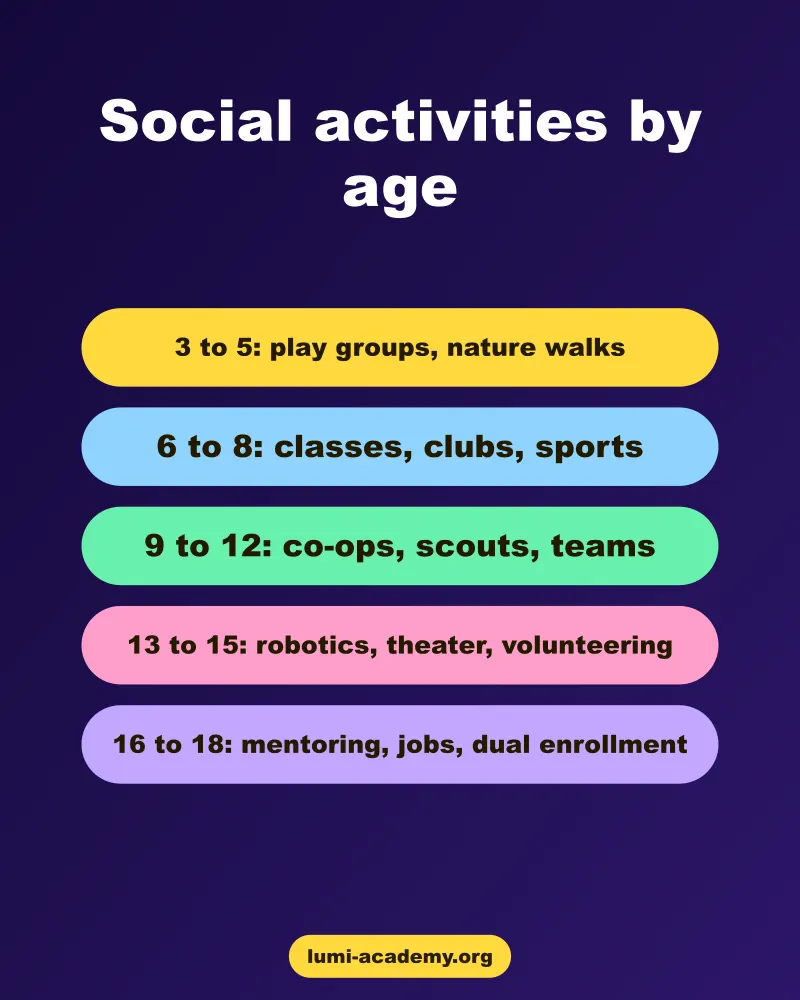
Match the activity to the age
What counts as a good social setting changes as children grow. Preschoolers need repeated, low-pressure time with familiar faces. Elementary kids want a shared project. Tweens and teens want independence and shared interests. Roundups from Weird Unsocialized Homeschoolers, The Schoolhouse and Not That Hard to Homeschool describe a similar pattern, and some sources warn that overscheduling is a real risk. Pick a few things and keep them regular.
Ages 3 to 5
- A small rotating play group with two or three families, hosted in turn.
- Weekly nature walks with a scavenger list.
- Library story time and toddler music or movement classes.
- Park meetups at the same time each week. Our park day guide shows how.
Ages 6 to 8
- A weekly class or club in art, music, science or a language.
- Beginner sports teams and swim lessons.
- Library programs for kids.
- Small co-op classes with a short teaching block.
- Playdates of two to four kids, one to two hours.
Ages 9 to 12
- A co-op or homeschool group with a regular schedule.
- Scouts, 4-H and similar clubs.
- Maker groups, LEGO clubs, chess clubs and book clubs. See how to start a club.
- Team sports and community theater.
- Nature center and museum homeschool days.
Ages 13 to 15
- Robotics, coding or tech clubs.
- Debate, mock trial and public speaking.
- Community theater, including backstage roles.
- Volunteering at a food bank, shelter or library.
- Library teen advisory boards.
Ages 16 to 18
- Mentorships and job shadowing with local professionals.
- Part-time jobs and internships.
- Dual enrollment or community college classes where available.
- Leadership roles in clubs and co-ops, including mentoring younger kids.
- Our guide to teen socialization goes deeper.
How to find what is near you
- Ask in local homeschool groups and at your library.
- Check the parks and recreation, YMCA and community center schedules.
- Look at museum, zoo and nature center homeschool days.
- Search for scouts, 4-H and sports leagues in your town.
- Use our co-op finder guide if you cannot find a group.
Do not overschedule
More is not always better. One or two recurring activities a week plus informal time with neighbors and family is enough for many kids. Watch your child's energy. If they come home drained and cranky every time, scale back.
Free and low-cost options
Good socialization does not have to be expensive. Library programs, park days, scout troops, church youth groups, community center classes, volunteer work and parent-run clubs are often free or cheap. Ask about homeschool discounts at museums and nature centers, and trade skills with other families: one parent teaches art, another leads a science morning. Many families find that the most reliable groups are the ones they built themselves.
- Start a co-op in Circles and invite families by link or QR code.
- Post meetups and let families RSVP and sign up to help.
- Use Lumi's lessons for the days between, with a free 48-hour trial to start.
Start the free 48-hour trial. The free trial covers the lessons. Lumi Circles is included once you subscribe to Lumi Academy or Lumi High.
Frequently asked questions
What social activities are good for homeschoolers?
Co-op classes, park days, clubs, sports, scouts and 4-H, library programs, theater, volunteering and mentorships, matched to the child's age and interests.
How many activities should a homeschooler do each week?
Many families do well with one or two recurring group activities plus informal time with friends and family. Watch your child's energy and scale back if they are worn out.
What are good social activities for teens who homeschool?
Robotics and tech clubs, debate, theater, volunteering, library teen boards, part-time jobs, mentorships and dual enrollment.
How do I find homeschool social groups near me?
Ask in local homeschool groups and your library, check community center and parks and recreation schedules, and use state homeschool association lists.