Start with the parents you have, not the classes you want
The best co-op class list is the one your families can actually deliver. Before you brainstorm, ask every parent three questions: what could you teach with an hour of prep, what would you love to learn, and what would your child never miss? Roundups from A Heart Full of Joy and Homeschool Picks are great for sparking ideas, but a class run by a parent who loves the subject usually beats a perfect plan run by someone who does not.
Ages 3 to 5: learning through the body
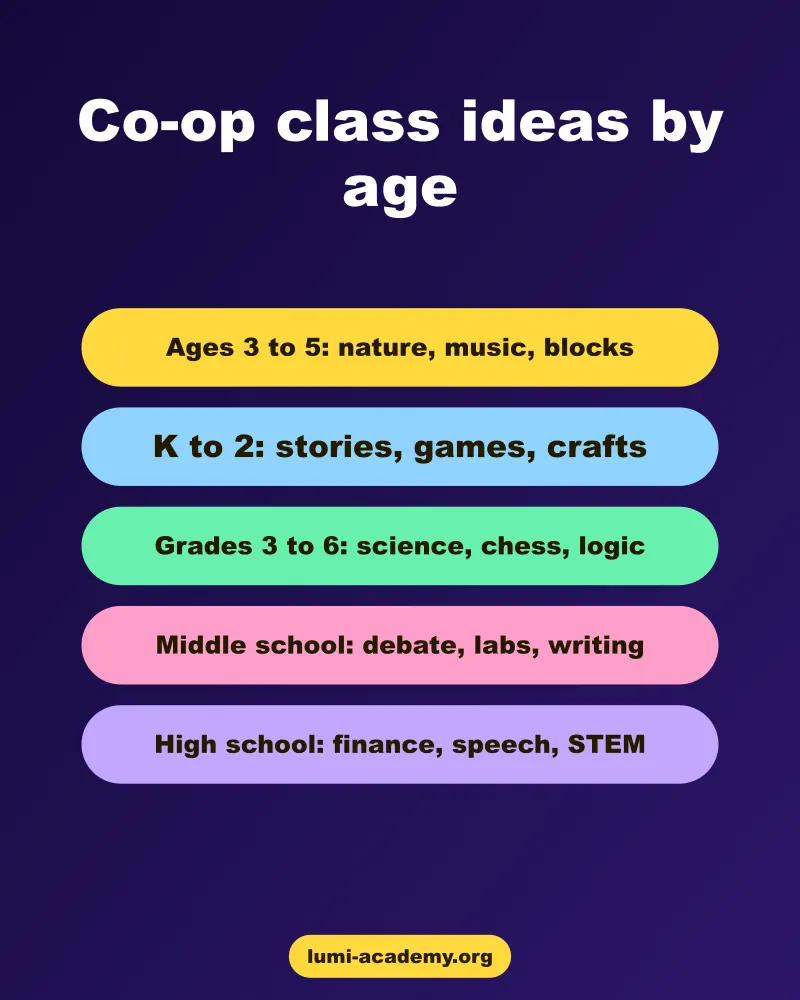
Keep sessions short and physical. Nature walks with leaf sorting, music and movement, block building, painting and read-aloud circles all work. Plan for a snack, a quiet corner and a parent in the room. The goal is a happy first experience of "class", not a lesson plan covered.
Kindergarten to grade 2: stories, games and simple projects
- Picture-book science, where you read a book and test one idea from it.
- Beginner art with one new technique each week.
- Music and rhythm with simple instruments.
- Show and tell, which quietly builds speaking confidence.
- Cooking with two or three steps and no sharp tools.
Grades 3 to 6: multi-step challenges
This is the age for group projects. Messy science experiments, chess and board game clubs, math games, LEGO or engineering challenges, geography clubs and creative writing groups all do well. Several co-op guides suggest grouping by skill rather than strict age so the pace feels right.
Middle school: independence and discussion
- Debate and public speaking.
- Lab-style science where equipment can be shared.
- Creative writing workshops with rotating discussion leaders.
- Geography or history through projects, not lectures.
- Entrepreneurship, where kids plan and run a tiny business.
Teens have their own list, covered in our guide to high school co-op classes.
Mixed-age classes that work
Some topics scale well across ages: a "country of the month" geography class, engineering challenges with difficulty levels, art studios, choir and sign language. Pair older and younger kids for a task so each has a role.
How to pick and schedule classes
- Survey families for teaching skills and interests.
- Pick a small set of classes, not a menu. Four to six is plenty to start.
- Match each class to a parent who is excited about it.
- Set a clear age range and a maximum class size.
- Run each class for one short term, then review what worked.
Our class lesson plan template helps new teachers get started, and the volunteer sign-up sheet keeps the supporting jobs covered.
- Narrated lessons for Pre-K through 12th grade handle reading, math, science and more at home, so co-op time is free for the fun classes.
- Mastery-based progress shows what each child has learned before you pick co-op classes.
- Try it free for 48 hours, no card needed.
Start the free 48-hour trial. Circles opens with a paid Lumi Academy or Lumi High plan; the free 48-hour trial lets you try the lessons first, no card needed.
Frequently asked questions
What classes can you offer at a homeschool co-op?
Popular options include art, music, nature study, science experiments, chess, debate, creative writing, geography, cooking and life skills. Choose classes your parents are excited to teach.
How many classes should a new co-op start with?
Start small with four to six classes and one short term. It is easier to add classes than to recover from an overloaded schedule.
Should co-op classes be grouped by age or skill?
Many co-ops group by age bands for young children and by skill level for older ones, so the pace suits everyone.
What if no parent wants to teach?
Offer shorter, easy-to-lead formats such as clubs, workshops or rotating guest sessions, and let a parent help rather than lead.