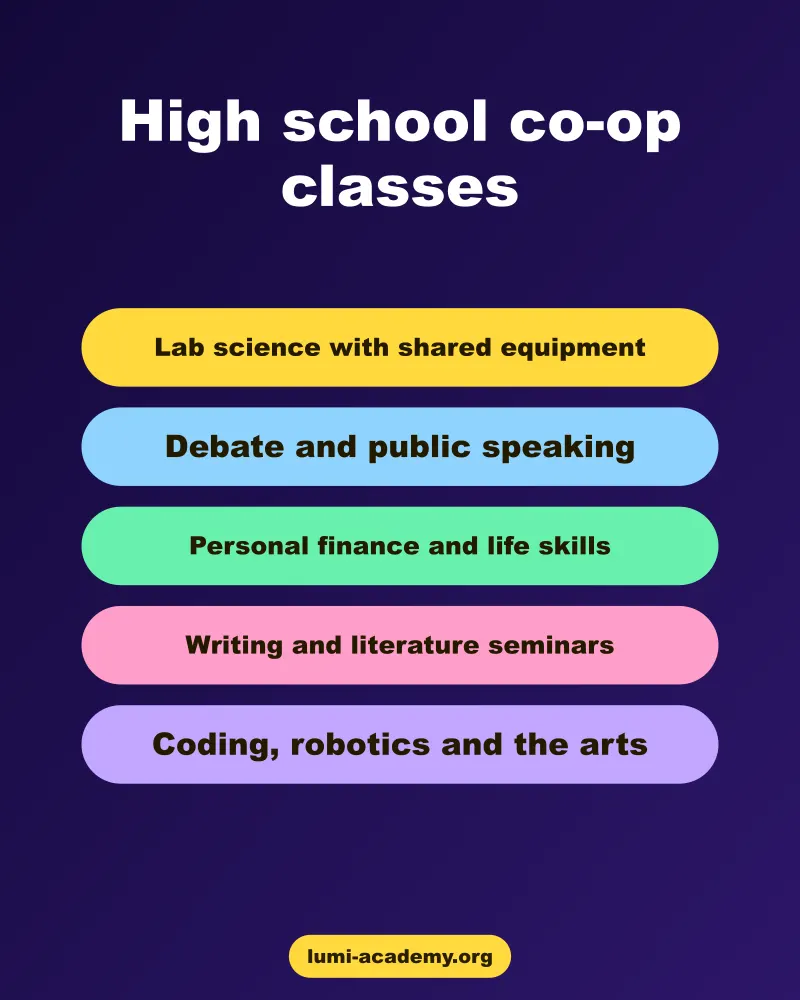
Why teens need a different kind of co-op class
High schoolers are not just older elementary kids. They want real challenge, real responsibility and time with friends who share their interests. A co-op is one of the best places to get that, because it can offer things that are hard to do alone: lab equipment, a debate team, a seminar with real discussion and a group to present to. Roundups like this one and this one from A Heart Full of Joy converge on the same few categories.
Classes that tend to work
| Category | Examples | Why a co-op helps |
|---|---|---|
| Lab science | Chemistry, biology, physics | Families share equipment and safety supervision. |
| Speech and debate | Public speaking, mock trial, formal debate | You need an audience and opponents. |
| Life skills and money | Personal finance, budgeting, car care, job applications | Practical skills that are easy to teach as a group. |
| Writing and reading | Literature seminars, creative writing, film versus book | Discussion improves with more voices. |
| Hands-on electives | Coding, robotics, cooking, art, music | Shared tools and a group project. |
| Service and leadership | Community service projects, mentoring younger kids | Builds responsibility and transcript-ready experience. |
Who can teach them
You do not need every class to be taught by an expert. Lab and seminar classes often work best when a parent with relevant work or hobby experience leads and other parents assist. Retired professionals, local college students or a family friend can be invited for a term. Be honest with families about what a class is: an enrichment class or one that counts for credit on a transcript. If your teens are working toward a diploma, our Lumi High courses can cover the core coursework at home while the co-op covers the group experiences.
Keeping teens engaged
- Let teens help choose the classes and, where they can, lead a session.
- Keep expectations clear: reading, projects and attendance matter.
- Plan time for friendship, since that is often why they come.
- Mix ages thoughtfully. High school classes should not be dragged down by much younger kids.
- Give older students real jobs, like running the sign-in or mentoring younger kids.
A note on online spaces for teens
Teens often want to chat with co-op friends between meetings. A parent-controlled space is safer than an open platform; see our checklist for judging online communities. In Lumi Circles, teens are placed in the two oldest age rooms and never share a room with younger children.
- Lumi High offers high school courses at home, so co-op time can be for debate, labs and seminars.
- It comes with Lumi Academy, so younger siblings are in the same plan.
- Try the free 48-hour trial first, no card needed.
Start the free 48-hour trial. The free trial covers the lessons. Lumi Circles is included once you subscribe to Lumi Academy or Lumi High.
Frequently asked questions
What classes should a high school homeschool co-op offer?
Common choices are lab science, speech and debate, personal finance and life skills, writing and literature, coding or robotics, art and music, and service projects.
Can co-op classes count for high school credit?
They can, if the class has a clear syllabus, hours and assessments. Many families keep a record of the work for the transcript. Check your state's requirements.
Who can teach high school co-op classes?
Parents with relevant experience, retired professionals, college students or guest instructors. Be clear about whether the class is enrichment or for credit.
How do you keep teens interested in a co-op?
Let them help choose classes, give them real responsibility, set clear expectations and leave time for friendships.