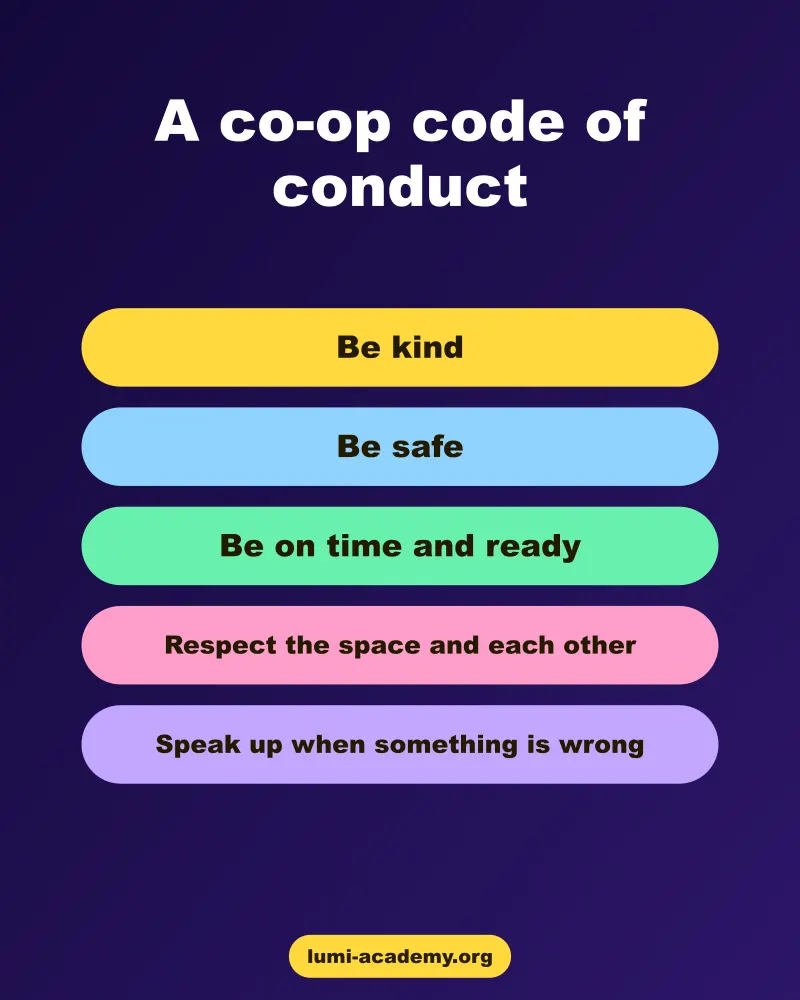
Why a short, positive code works better than a long list
A code of conduct should be something a seven-year-old can remember and a parent can point to. Long lists of prohibitions invite arguments about edge cases. A few clear expectations, written positively, with a plain statement of what happens when they are not met, resolve most situations before they become conflicts. Pair it with your bylaws so there is one place that explains how concerns are handled.
Kids' code (read it aloud on day one)
OUR CO-OP PROMISES
1. We are kind with our words and our hands.
2. We listen when someone is teaching.
3. We stay with our group and ask before we leave a room.
4. We take care of the space and each other's things.
5. We tell a grown-up if something does not feel right.
Parents' code
PARENT EXPECTATIONS
1. I stay responsible for my child, or I name another adult in writing.
2. I arrive on time and help with my share of jobs.
3. I talk to the director, not the group, when I have a concern.
4. I speak about other families and children with respect, in person and online.
5. I do not discipline another family's child. I tell a leader instead.
6. I follow the co-op's safety and privacy rules, including no sharing of other families' photos or details.
What happens when someone breaks the code
- A calm, private reminder from a leader.
- A conversation with the parent if it happens again, with a plan for what will change.
- A short break from a class or activity if behavior is unsafe or very disruptive.
- A pause or end to membership for serious or repeated problems, handled as your bylaws describe.
Write down the steps and who decides. A rule that nobody enforces is worse than no rule.
Online conduct
Many co-op problems start in group chats. Add a short section for online behavior: co-op chat is for co-op business and friendly talk, no screenshots of private conversations, no pressure to buy or sell, and no sharing of children's photos without permission. Our communication tools guide compares the places co-ops usually chat, and the online safety checklist helps if kids are involved.
Make it part of joining
Include the code in your registration form and ask each family to sign. Read it aloud at the first meeting and keep a copy visible at every session.
Teaching the code to kids
Do not just hand children a list. Read each promise aloud, ask what it looks like in real life, and let them act out one or two situations: a child grabbing a toy, a friend left out of a game, a game getting too rough. Ten minutes of role play on the first day teaches more than a laminated poster. Praise kids who follow the code in the moment so they hear what good behavior sounds like.
- Circles shows families your rules and joining questions before they are accepted.
- In the optional kids' room, flagged messages are hidden until a grown-up reviews them.
- Lumi is included with a paid plan, with a free 48-hour trial of the lessons.
Start the free 48-hour trial. No card is needed for the 48-hour trial. Circles is part of the paid Academy and High plans.
Frequently asked questions
What should a homeschool co-op code of conduct include?
Short, positive expectations for kids and for parents, how concerns are raised, what happens after repeated problems and rules for online behavior.
How do you handle a child who keeps disrupting class?
Start with a calm private reminder, talk with the parent, and consider a short break from the activity. Repeated or unsafe behavior may lead to a pause in membership, as your bylaws describe.
Should parents sign the code of conduct?
Yes. Include it in your registration form so every family agrees before they join.
Does the code cover group chats?
It should. Add a short section on online behavior, privacy and sharing photos.