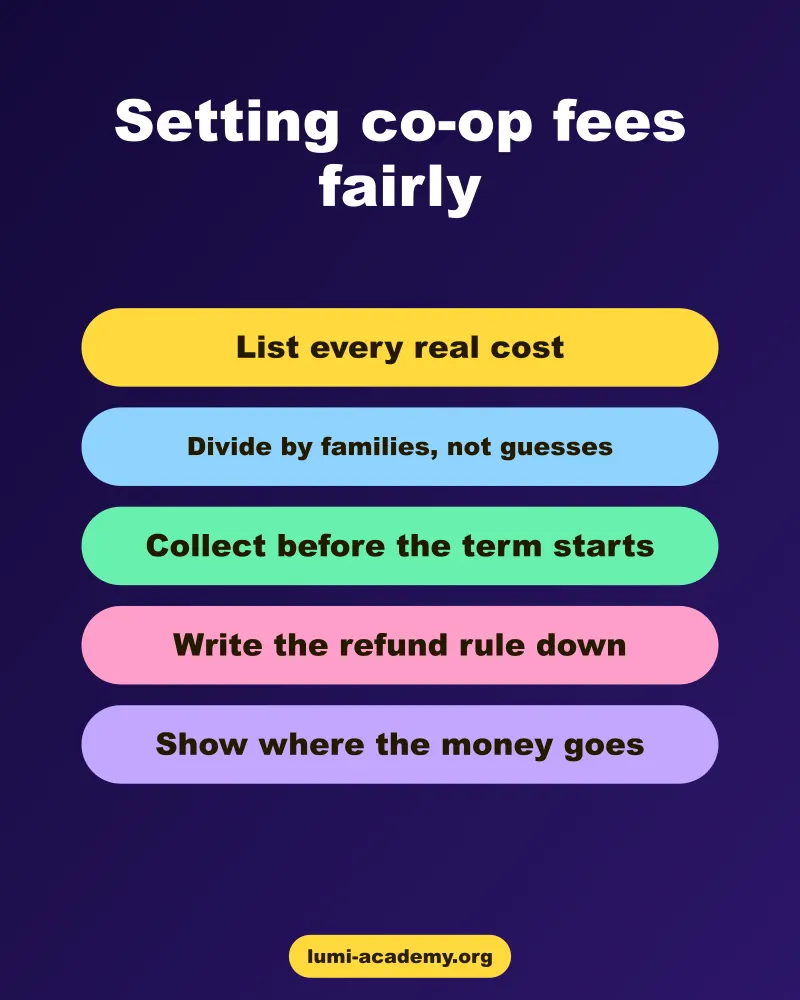
Dues exist to cover real costs, nothing more
The fairest co-op fee is the smallest number that covers what the group actually spends. Informal groups that meet at a park or a free room may not need dues at all. Co-ops that rent space, pay teachers or buy supplies do. Guides such as this tuition and fees guide and this membership fee glossary describe a very wide range, from nothing to well over a thousand dollars a year, and say the biggest driver is whether instructors are paid and whether the group rents a building.
What dues usually cover
| Cost | Notes |
|---|---|
| Space | Often the biggest cost. A donated church or library room can bring it to zero. |
| Insurance | Some venues require proof of coverage. Ask your host before assuming. |
| Supplies | Art, science and craft materials, often charged per class. |
| Teacher stipends | Only if some instructors are paid. |
| Admin and tools | Printing, background checks if required, and any software. |
| A cushion | A small reserve so one late payment does not sink a term. |
A simple way to work out a fair number
- Add up the expected costs for the whole term, including the cushion.
- Divide by the number of families you expect, then by the number of children if fees are per child.
- Round up slightly and write down what the money covers.
- Charge separate class fees only for classes with real supply costs.
- Review after the first term and adjust.
One planning rule from the guides is to stay conservative on how many families you count. If the plan only works with every spot filled, the first family to leave creates a shortfall.
Charge per family or per child?
Per family keeps bookkeeping simple and works when costs are mostly space and admin. Per child is fairer when supplies and class sizes grow with each child. Many groups use a flat family registration fee plus per-child class fees.
Collect it painlessly
- Set a due date before the term starts and keep it.
- Say clearly what happens if a payment is late.
- Use a payment method that leaves a record, and keep a simple ledger.
- Share a short summary of where the money went at the end of each term.
- Offer a quiet way for families in a tight spot to talk to the treasurer privately.
Write the refund rule before anyone asks
Refund disputes are among the most common co-op friction points. Decide the rule in advance, for example a full refund before the first meeting and a partial refund before the midpoint, and put it in your bylaws and registration form. The ranges above come from general guides, so use them as a sanity check, not a rule. If your co-op handles significant money, check your state's rules.
- Your co-op fees cover the group. Lumi covers the core curriculum with one flat plan for up to 8 learners.
- Circles is included with a paid plan, so there is no separate community fee to collect.
- Try the lessons free for 48 hours first.
Start the free 48-hour trial. The free trial covers the lessons. Lumi Circles is included once you subscribe to Lumi Academy or Lumi High.
Frequently asked questions
How much do homeschool co-ops charge?
It varies widely. Volunteer-run groups in free spaces may charge little or nothing, while co-ops that rent buildings or pay teachers charge much more. Work out your own costs instead of copying a number.
What do homeschool co-op dues pay for?
Typically space, insurance, supplies, any teacher stipends, admin costs and a small reserve.
Should co-op fees be per family or per child?
Per family keeps things simple. Per child is fairer when supply costs grow with each child. Many groups use a family registration fee plus per-child class fees.
Should a co-op offer refunds?
Decide the rule in advance and write it in your bylaws and registration form. Many groups give a full refund before the first meeting and a partial one before the midpoint.