The short version
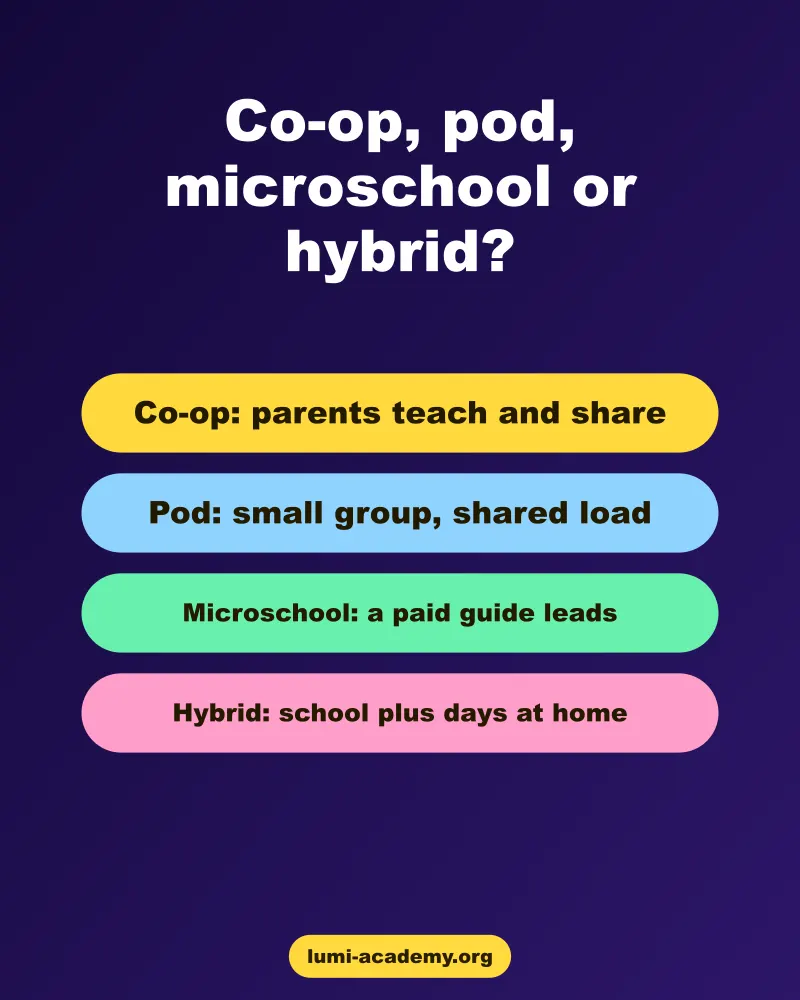
These four terms are used loosely, and sources do not always agree on the boundaries. The most reliable way to tell them apart is to ask two questions: who teaches, and who owns the academic plan. Comparisons from Outschool, Teacher Jade and Homeschool Academics follow the same pattern.
| Model | Who teaches | Typical rhythm | Who owns the plan |
|---|---|---|---|
| Homeschool co-op | Parents, sometimes hired instructors | One or two days a week, supplementing home learning | The parent |
| Learning pod | Parents sharing the load, or one hired teacher | A small group, often 3 to 10 kids, flexible | The parents together |
| Microschool | A paid educator or guide | Small, often mixed-age, several days a week | The educator |
| Hybrid school | School staff on campus, parents at home | Part of the week on campus, the rest at home | The school |
Homeschool co-op
A co-op is a community more than a school. Parents run it, classes are usually a supplement to what happens at home, and costs are typically modest because families share the work. It suits parents who want to keep control of the curriculum but want enrichment and company. Start with our co-op finder guide.
Learning pod
A pod is smaller and more casual than a co-op. A few families share the teaching, rotate homes or hire a tutor, and run on a handshake agreement. Pods are flexible but fragile: they depend on a few people, so it helps to write down a few agreements. See our pod guide.
Microschool
A microschool hands the academic plan to a paid guide. Students are in a small group, often mixed-age, several days a week. It is closer to a school than a co-op, and costs are usually higher because someone is being paid full time. Check how your state treats microschools before enrolling.
Hybrid school
A hybrid school is the most formal of the four. Students attend class on campus part of the week and learn at home the rest, following the school's curriculum. Definitions and legal status vary, so confirm how the program is classified where you live.
How to choose
- Want to stay in charge of the curriculum? Co-op or pod.
- Want someone else to teach several days a week? Microschool or hybrid.
- Want the lowest cost and the most flexibility? Co-op.
- Starting with two or three friends? A pod, then grow into a co-op.
- Far from other families? A virtual co-op can bridge the gap.
Whichever model you pick, a few written rules prevent most problems.
- Lumi Academy gives you a full Pre-K to 12th grade curriculum for home days, in a co-op or a pod.
- One flat plan covers up to 8 learners, and Lumi High comes with it for older students.
- Circles gives your group a private place to plan together.
Start the free 48-hour trial. Circles opens with a paid Lumi Academy or Lumi High plan; the free 48-hour trial lets you try the lessons first, no card needed.
Frequently asked questions
What is the difference between a co-op and a microschool?
A co-op is run by parents who share teaching and keep the academic plan at home. A microschool hands the plan to a paid educator who leads a small group several days a week.
Is a learning pod the same as a co-op?
They overlap. A pod is usually smaller and more informal, often 3 to 10 children, while a co-op tends to be larger with a regular class schedule.
What is a hybrid school?
A school where students attend class on campus part of the week and learn at home the rest, following the school's curriculum.
Which is cheapest?
Co-ops and pods are usually the least expensive because parents share the work. Microschools and hybrid schools charge more because staff are paid.